
Introduction
Creating quality content takes more than simply putting words on a page. Bloggers, marketers, students, businesses, and freelancers often spend hours researching topics, creating outlines, editing drafts, and repurposing content.
The right AI writing tools can reduce this workload by helping with brainstorming, drafting, rewriting, grammar, SEO planning, and content optimization. They work best as assistants rather than replacements for human creativity and expertise.
In this guide, we’ll compare the best AI writing tools for content creation in 2026, including their strongest features, ideal users, advantages, limitations, and practical use cases.
Key Takeaways
| Tool | Best For | Free Option |
|---|---|---|
| ChatGPT | All-purpose writing | ✅ |
| Jasper AI | Marketing teams | Limited |
| Copy.ai | Marketing copy | ✅ |
| Writesonic | SEO content | ✅ |
| Grammarly AI | Editing | ✅ |
| QuillBot | Paraphrasing | ✅ |
| Rytr | Beginners | ✅ |
| Wordtune | Rewriting | ✅ |
| Anyword | Marketing optimization | Trial/Varies |
| Sudowrite | Creative writing | Limited |
Why AI Writing Tools Matter
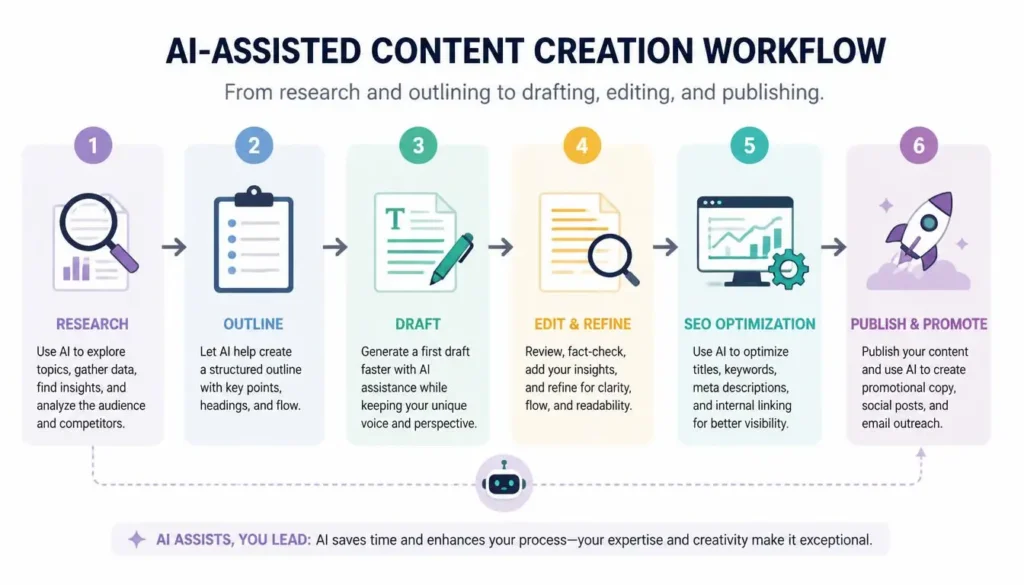
Modern content creation involves much more than writing. Writers may need to research topics, create SEO-friendly outlines, draft articles, improve grammar, write emails, create social posts, and turn long-form content into shorter formats.
AI writing tools simplify many of these repetitive tasks. When combined with human research, editing, and fact-checking, they can make the content creation process considerably more efficient.
1. ChatGPT — Best All-Purpose AI Writer
ChatGPT is one of the most versatile options for content creators. It can help generate blog ideas, create outlines, rewrite paragraphs, summarize research, draft emails, and produce social media copy.
Best Uses
- Blog writing
- Content planning
- Marketing copy
- Educational content
- Research assistance
Pros: Highly versatile, natural writing, strong brainstorming, and support for multiple formats.
Cons: Requires fact-checking, and results depend heavily on the quality of your prompts.
Pricing: Free plan available, with premium options offering additional capabilities.
Best For: Bloggers, freelancers, students, businesses, and general content creators.
2. Jasper AI — Best for Marketing Teams
Jasper AI is built primarily for professional marketers and content teams. Its features focus on creating consistent marketing content and maintaining a recognizable brand voice.
Key Strengths
- Marketing templates
- Brand voice customization
- Long-form editor
- Campaign creation
- Team collaboration
Best For: Marketing agencies, businesses, and professional content teams.
Main Limitation: Its pricing can be higher than several competitors, making it more suitable for regular business use.
3. Copy.ai — Best for Marketing Copy
Copy.ai focuses on producing short-form marketing content quickly. It supports emails, social media posts, product descriptions, advertising copy, and business workflows.
Pros: Easy to learn, fast generation, and useful workflow automation.
Cons: Long-form content may need additional editing.
Best For: Entrepreneurs, startups, ecommerce businesses, and digital marketers.
4. Writesonic — Best for SEO Content
Writesonic combines AI writing with SEO-focused features, making it useful for bloggers, affiliate marketers, and website owners.
It can help create blog articles, website copy, landing pages, and product descriptions.
Pros: SEO-oriented workflow, multiple templates, and an accessible interface.
Cons: Some advanced features require higher-tier plans.
Best For: Bloggers and publishers focused on search-driven content.
5. Grammarly AI — Best for Editing
Grammarly AI is particularly useful when you already have a draft that needs improvement. It can identify grammar problems, improve clarity, adjust tone, and rewrite sentences.
Pros: Accurate grammar suggestions, browser integration, and simple workflow.
Cons: It isn’t primarily designed to generate complete long-form articles from scratch.
Best For: Students, professionals, writers, and editors.
6. QuillBot — Best for Paraphrasing
QuillBot focuses on improving existing writing through paraphrasing, summarization, grammar correction, translation, and citation support.
Pros: Strong paraphrasing, useful summarization, and simple interface.
Cons: Less suitable for creating complete long-form articles from an empty page.
Best For: Students, researchers, bloggers, and writers refining drafts.
7. Rytr — Best Budget-Friendly Option
Rytr provides ready-made templates for blog posts, emails, social media content, and product descriptions. Its straightforward interface makes it suitable for beginners.
Pros: Affordable, easy to use, and offers multiple content templates.
Cons: Longer outputs may require more editing.
Best For: Beginners, freelancers, and small businesses.
8. Wordtune — Best for Rewriting
Wordtune focuses on improving existing sentences rather than generating entire articles. It can rewrite text, adjust tone, improve grammar, and make writing easier to understand.
Best For: Students, professionals, and business writers.
Pros: Natural rewrites, clarity improvements, and convenient browser integration.
Cons: Limited full-content generation capabilities.
9. Anyword — Best for Marketing Optimization
Anyword is designed for marketers who want to create and optimize advertising, email, and campaign copy. It also provides performance-oriented insights and audience targeting features.
Pros: Marketing-focused, data-driven suggestions, and optimization tools.
Cons: Less suitable for creative long-form writing.
Best For: Ecommerce businesses, advertisers, and marketing agencies.
10. Sudowrite — Best for Creative Writers
Sudowrite takes a different approach by focusing on fiction and storytelling. It can assist with dialogue, character development, scene creation, and story expansion.
Pros: Strong storytelling support and useful for overcoming writer’s block.
Cons: Not designed primarily for SEO blogs or business content.
Best For: Authors, screenwriters, and creative writers.
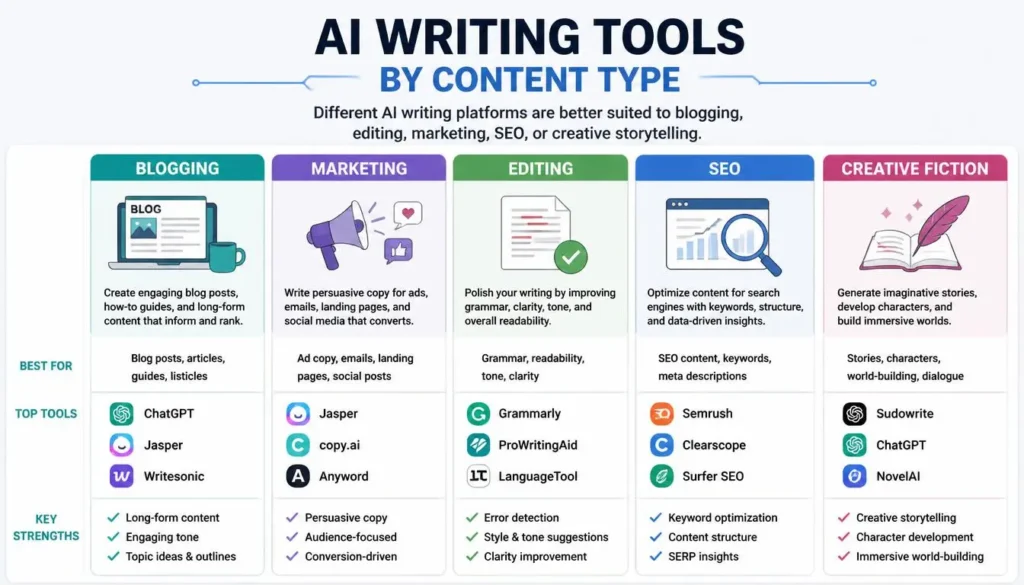
AI Writing Tools Comparison
| Tool | Best For | Main Strength |
|---|---|---|
| ChatGPT | General writing | Versatility |
| Jasper AI | Marketing | Brand voice |
| Copy.ai | Marketing copy | Templates |
| Writesonic | SEO blogs | SEO workflow |
| Grammarly AI | Editing | Grammar & clarity |
| QuillBot | Rewriting | Paraphrasing |
| Rytr | Beginners | Affordable templates |
| Wordtune | Editing | Sentence rewriting |
| Anyword | Marketing | Copy optimization |
| Sudowrite | Fiction | Storytelling |
How to Choose the Best AI Writing Tool
Choosing the right platform depends on your content goals, budget, workflow, and editing requirements.
- Define your goal: Decide whether you need blogging, editing, marketing, SEO, or creative writing.
- Check content quality: Choose a tool that produces clear and useful drafts.
- Compare pricing: Free plans can work for occasional users, while frequent creators may benefit from paid features.
- Review integrations: Browser extensions, document tools, and publishing integrations can save additional time.
- Check SEO features: For websites, look for useful outlining and optimization capabilities.
💡 Pro Tip: Don’t choose an AI writer simply because it generates the longest article. A tool that fits your workflow and produces a useful first draft can save more time than one with dozens of unnecessary features.
Can AI Writing Tools Replace Human Writers?
No—not entirely.
AI can generate drafts, suggest headlines, summarize information, improve grammar, and overcome writer’s block. But strong content still needs human judgment, originality, expertise, storytelling, and fact-checking.
A blogger can use AI for an outline but add real experience. A business can generate product descriptions and then adjust them to match its brand. A student can use AI to understand a subject while following academic integrity rules.
The strongest workflow combines AI efficiency with human expertise.
Frequently Asked Questions (FAQs)
What is the best free AI writing tool?
ChatGPT is a strong general-purpose option. Grammarly AI, QuillBot, and Rytr are also useful when you need specialized editing, paraphrasing, or template-based writing.
Are AI writing tools good for SEO?
Yes, they can help with outlines, readability, and content organization. However, rankings still depend on accuracy, search intent, originality, and overall content quality.
Can AI tools write complete blog posts?
Yes. Many platforms can create complete drafts, but writers should review, fact-check, and personalize them before publishing.
Which AI writing tool is best for beginners?
ChatGPT, Rytr, and Grammarly AI are beginner-friendly because their workflows are relatively straightforward.
Is AI-generated content suitable for Google AdSense?
AI-assisted content can be useful when it provides original, accurate, helpful value. Simply publishing unedited AI-generated text is unlikely to satisfy quality expectations.
Final Conclusion & Actionable Verdict
The best AI writing tool for content creation in 2026 depends on what you’re trying to accomplish.
For general writing and brainstorming, ChatGPT is an excellent all-around choice. Bloggers focused on SEO can consider Writesonic, while marketing teams may prefer Jasper AI, Copy.ai, or Anyword. For editing, Grammarly AI, QuillBot, and Wordtune are particularly useful. Creative writers have a more specialized option in Sudowrite.
The smartest approach is not to let AI replace your voice. Use it to handle repetitive work, generate starting points, and improve drafts while you remain responsible for research, accuracy, originality, and final quality.
About the Author
Written by the NestAIHub Editorial Team, technology researchers and content editors specializing in AI tools, content creation, and digital productivity. Our goal is to provide practical technology guidance that helps readers choose and use AI tools more effectively.