Introduction
Artificial intelligence is no longer a futuristic idea. In 2026, AI is already part of everyday life, from chatbots and voice assistants to movie recommendations, image generators, and smart devices.
For beginners, however, terms such as machine learning, deep learning, neural networks, and natural language processing can make AI seem complicated. The good news is that you don’t need to be a programmer or data scientist to understand the basics.
This beginner-friendly guide explains what AI is, how it works, where it is used, its benefits and challenges, and how beginners can start learning it.
⚠️ Educational Disclaimer: This article is for educational and informational purposes only. AI systems can produce inaccurate or outdated information, so important decisions should always be verified using reliable sources and qualified professionals where appropriate.
Key Takeaways
| Key Aspect | Simple Explanation |
|---|---|
| What is AI? | Technology that performs tasks associated with human intelligence |
| Main Technologies | Machine learning, deep learning, NLP, neural networks, computer vision |
| AI Today | Mostly Narrow AI designed for specific tasks |
| Popular Uses | Education, business, healthcare, finance, entertainment |
| Beginner Tools | ChatGPT, Gemini, Copilot, Canva AI, Perplexity |
| Main Benefit | Saves time and improves productivity |
| Main Challenge | Accuracy, privacy, bias, and responsible use |
What Is Artificial Intelligence?
Artificial Intelligence (AI) is a branch of computer science focused on creating software and machines capable of performing tasks that normally require human intelligence.
AI systems can analyze information, recognize patterns, learn from data, generate responses, and make predictions.
In simple terms, AI allows computers to perform certain tasks in ways that resemble human intelligence. However, AI does not literally think like a human. It processes information and produces outputs based on patterns learned from data.
Everyday Examples of AI
You may already use AI without realizing it:
- ChatGPT and Google Gemini
- Siri and Alexa
- Netflix recommendations
- YouTube suggestions
- Spotify recommendations
- Google Translate
- Face recognition
- Spam filters
- AI image generators
These systems use AI to provide automated or personalized experiences.
How Does Artificial Intelligence Work?
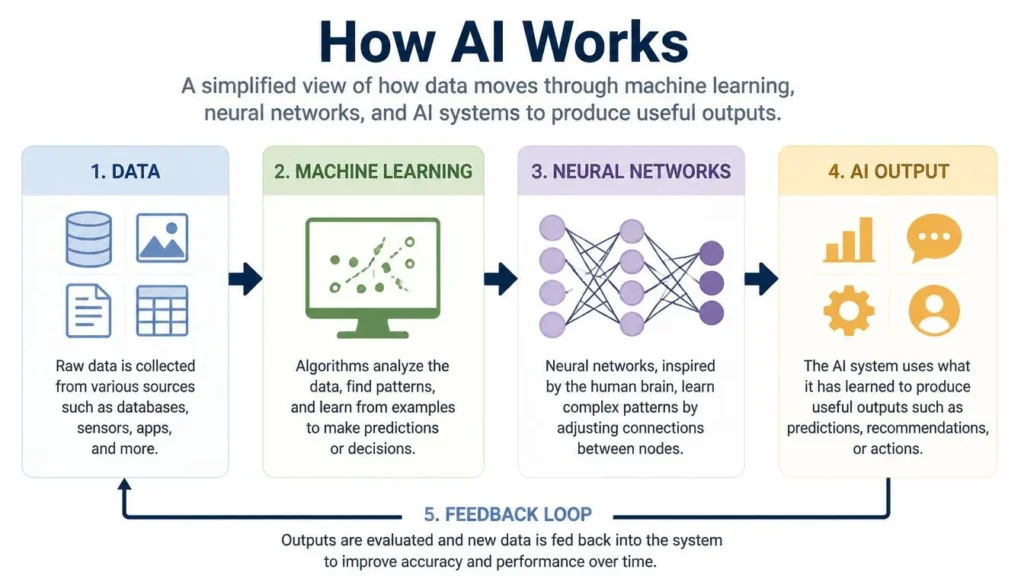
AI relies on several technologies. Understanding five basic concepts makes the subject much easier.
Machine Learning
Machine Learning (ML) allows computers to learn patterns from data instead of receiving every rule manually.
For example, if an AI system receives thousands of cat and dog images, it can learn differences between them and later classify a new image.
ML powers spam filters, recommendation systems, fraud detection, product suggestions, and voice assistants.
Deep Learning
Deep learning is an advanced form of machine learning that uses complex mathematical models to process large amounts of information.
It supports technologies such as:
- Image generation
- Speech recognition
- Language translation
- Medical image analysis
- Autonomous driving technology
Neural Networks
Neural networks are a foundation of deep learning. They process information through multiple layers and produce an output.
For example, when analyzing a flower image, a neural network can examine characteristics such as shape, color, petals, size, and texture before predicting the flower type.
Natural Language Processing
Natural Language Processing (NLP) helps computers understand and generate human language.
It powers chatbots, translators, grammar tools, voice assistants, and AI systems such as ChatGPT and Gemini.
Computer Vision
Computer vision allows AI to interpret images and videos. It can identify objects, text, faces, and other visual information.
Common applications include smartphone face unlock, medical scans, security cameras, image search, and AI photo editing.
Types of Artificial Intelligence
AI is commonly described using three categories based on capability.
1. Narrow AI
Narrow AI, also called Weak AI, is the type widely available today. It is designed for specific tasks.
Examples include ChatGPT, Gemini, Siri, Alexa, recommendation systems, and writing assistants.
2. Artificial General Intelligence
AGI refers to a theoretical form of AI capable of performing a broad range of intellectual tasks at a human-like level.
The source describes AGI as a research goal rather than a publicly available technology.
3. Super AI
Super AI describes a theoretical system that would surpass human intelligence across areas such as science, creativity, engineering, medicine, and decision-making.
It does not currently exist and remains a theoretical concept.
Where Is AI Used?
AI has applications across many industries.
Education
AI supports personalized learning, tutoring, homework assistance, translation, study planning, and automated grading.
Healthcare
Healthcare organizations use AI for medical image analysis, disease detection, drug research, patient monitoring, and administrative tasks.
Business
Businesses use AI for customer support, sales forecasting, workflow automation, reporting, and email assistance.
Marketing
AI helps marketing teams create blog content, social posts, email campaigns, advertising copy, and SEO recommendations.
Finance
Financial institutions use AI for fraud detection, risk analysis, investment research, customer support, and expense tracking.
Entertainment
Recommendation engines, AI-generated content, video editing, game development, and personalized media experiences all use AI.
Benefits and Challenges of AI
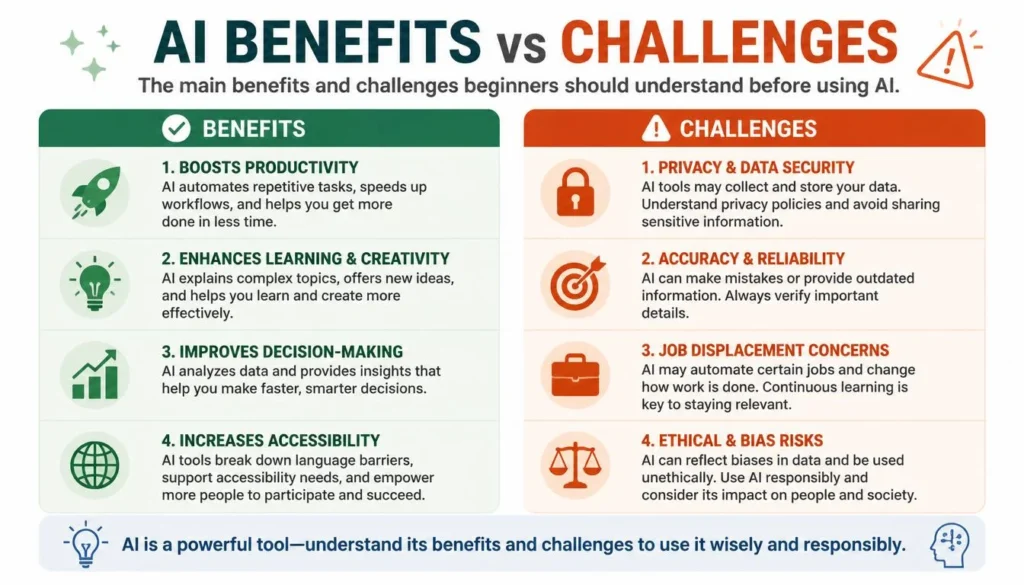
Major Benefits
Time savings: AI can quickly draft content, summarize documents, organize information, and analyze data.
Higher productivity: AI can act as a digital assistant for everyday tasks.
Better decisions: AI can process large amounts of information and highlight patterns and trends.
Personalization: Recommendation systems can tailor content to individual preferences.
Faster research: AI tools can summarize information and explain difficult subjects.
Important Challenges
AI also has limitations. Privacy, job changes, inaccurate outputs, and ethical concerns remain important issues. AI-generated information should be verified, especially when the consequences of an error are significant.
💡 Pro Tip: Treat AI as an assistant, not an unquestionable authority. Verify important information and protect confidential data.
How Beginners Can Start Learning AI
You don’t need advanced programming skills to begin.
- Learn the basics: Understand AI, machine learning, deep learning, prompting, and automation.
- Try popular tools: Experiment with ChatGPT, Gemini, Copilot, Canva AI, Notion AI, and Perplexity.
- Practice prompting: Give clear, specific instructions rather than vague questions.
- Follow AI developments: Technology changes quickly, so continue learning.
- Use AI responsibly: Verify information, protect personal data, and continue developing your own skills.
Best AI Tools for Beginners
| Tool | Best For |
|---|---|
| ChatGPT | Learning, writing, coding |
| Google Gemini | Research & Google services |
| Microsoft Copilot | Microsoft productivity |
| Canva AI | Design & presentations |
| Perplexity | AI-powered research |
| Notion AI | Notes & organization |
These tools provide different entry points for beginners who want practical experience with AI.
Frequently Asked Questions (FAQs)
What is artificial intelligence in simple words?
AI is technology that enables computers to perform tasks such as recognizing patterns, learning from information, solving problems, and communicating in ways that resemble human intelligence.
How does AI work?
AI uses technologies including machine learning, deep learning, neural networks, NLP, and computer vision to process information and produce outputs.
How does AI work?
AI uses technologies including machine learning, deep learning, neural networks, NLP, and computer vision to process information and produce outputs.
Is AI difficult to learn?
No. Beginners can start with basic concepts and everyday AI tools before gradually exploring more advanced topics.
What are common examples of AI?
Examples include ChatGPT, Gemini, Siri, Alexa, recommendation systems, AI image generators, Google Translate, and smart devices.
Will AI replace humans?
AI can automate certain tasks, but human creativity, judgment, empathy, and decision-making remain important.
Final Conclusion & Actionable Verdict
Artificial intelligence has moved from being a futuristic concept to an everyday technology. From education and healthcare to business, finance, entertainment, and personal productivity, AI is already changing how people work and interact with technology.
For beginners, the best approach is not to learn everything at once. Start with the fundamentals, experiment with a few practical tools, improve your prompting skills, and always verify important information.
The real value of AI comes from using it responsibly and intelligently. When combined with human judgment and critical thinking, AI can become a powerful assistant for learning, creativity, research, and productivity.
About the Author
Written by the NestAIHub Editorial Team, technology researchers and content editors specializing in artificial intelligence, digital productivity, and practical technology guides.

0 Comments