AI writing tools have made creating content faster than ever. You can generate an article, rewrite a paragraph, fix grammar, or turn rough notes into a polished draft in seconds.
But there is another problem.
The more generic the writing sounds, the more readers may feel that something is missing. At the same time, AI detection tools have become more sophisticated. Turnitin, for example, continues to update its detection models and now also considers text that may have been AI-generated and subsequently paraphrased.
So, how do you make AI-assisted writing sound genuinely human in 2026?
The answer is not a magic “AI humanizer.” It starts with changing how the content is created.
Stop Chasing a “0% AI” Score
This is probably the biggest misconception.
There is no universal AI detector score that proves whether something is human-written. Detection systems can make mistakes, and even Turnitin says its AI report should not be treated as definitive evidence on its own.
That means trying different paraphrasing tools until one reports “human” is not a reliable content strategy.
Instead, focus on something more valuable:
Could a real person read this and believe another real person wrote it?
That requires originality, context, judgment, and a recognizable writing voice.
Start With Your Own Ideas
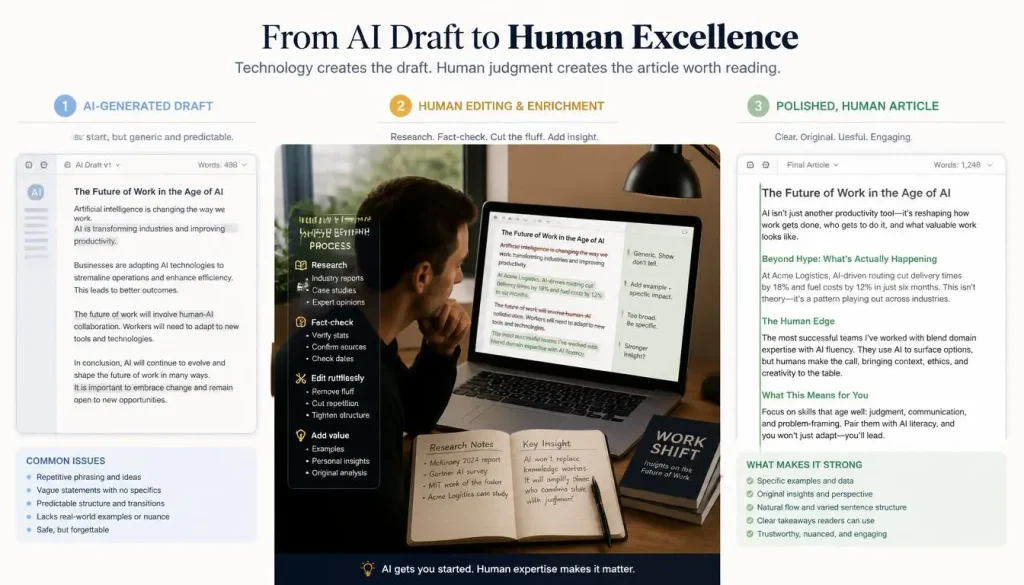
One of the easiest ways to make AI writing feel artificial is to let the AI create everything from scratch.
Instead, give it something that actually comes from you.
That could be:
- Your personal experience
- Notes from your research
- A real example
- Your opinion on the topic
- A customer question
- Results from something you tested
- Mistakes you made and what you learned
For example, instead of asking an AI to write “Best AI tools for students,” first write down which tools you have actually tested and what you liked or disliked about them.
AI can help organize those ideas, but the experience comes from you.
Rewrite Ideas, Not Just Words
Replacing words with synonyms is not the same as editing.
A paragraph can use completely different words and still sound exactly like AI-generated content.
Good editing changes the thinking and structure.
Look for sentences that feel too polished, repetitive, or predictable. Then ask:
- Would I actually say this?
- Is this sentence necessary?
- Can I explain this with a real example?
- Does this paragraph add something new?
- Is there a simpler way to say it?
Sometimes the best edit is deleting a sentence rather than rewriting it.
Add Specific Details
Generic writing is easy to produce because it does not require much knowledge.
Compare:
“AI can save businesses time and improve productivity.”
with:
“A small agency can use automation to turn website inquiries into organized CRM records and follow-up emails without manually copying every lead.”
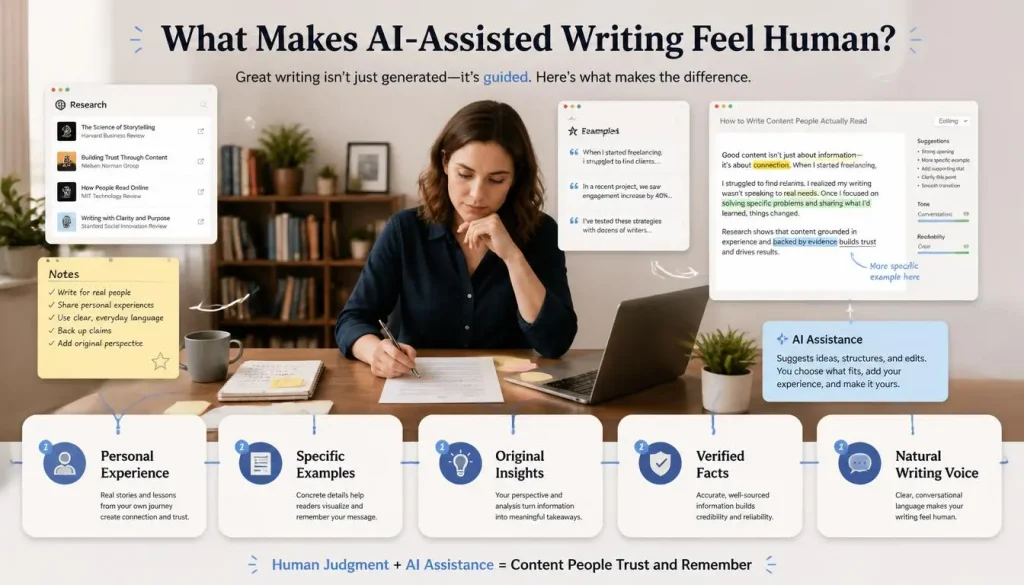
The second example feels more useful because it describes an actual situation.
Specificity creates personality.
Use real scenarios, numbers when you can verify them, practical examples, limitations, and details that someone familiar with the subject would naturally mention.
Break the Perfect Writing Pattern
AI-generated drafts often have a predictable rhythm: introduction, three benefits, three limitations, conclusion.
Real people are not always that neat.
A human writer might start with an unexpected observation, use a short sentence for emphasis, explain something through a personal example, or spend more time on one issue because it matters more.
You don’t need to make your writing messy.
You simply need to make it less mechanical.
Vary sentence length. Use natural transitions. Remove unnecessary headings. Let important ideas receive more attention than minor ones.
Don’t Use “Humanizer” Tools as a Shortcut
AI paraphrasers and so-called humanizer tools may change wording, but they do not automatically add expertise or original thinking.
In fact, detection systems are evolving specifically around AI-generated text that has been modified by paraphrasing or bypassing tools. Turnitin’s current guidance explicitly discusses detection of AI-generated text that may have been altered using paraphrasers or bypassers.
If your goal is quality content, a better workflow is:
AI draft → fact-check → add your experience → restructure → rewrite naturally → proofread
Not:
AI draft → humanizer → publish
Make SEO Serve the Reader
There is another important point for website owners.
Trying to make an article “undetectable” should never become more important than making it useful.
Google’s current guidance says content should provide original information, analysis, expertise, and value instead of simply rewriting what already exists. It also specifically warns against creating content primarily to manipulate search rankings.
That means your primary goal should be reader satisfaction, not an AI detector percentage.
Use your keyword naturally. Answer the actual search intent. Add useful examples. Link to trustworthy sources. Make the page easy to read.
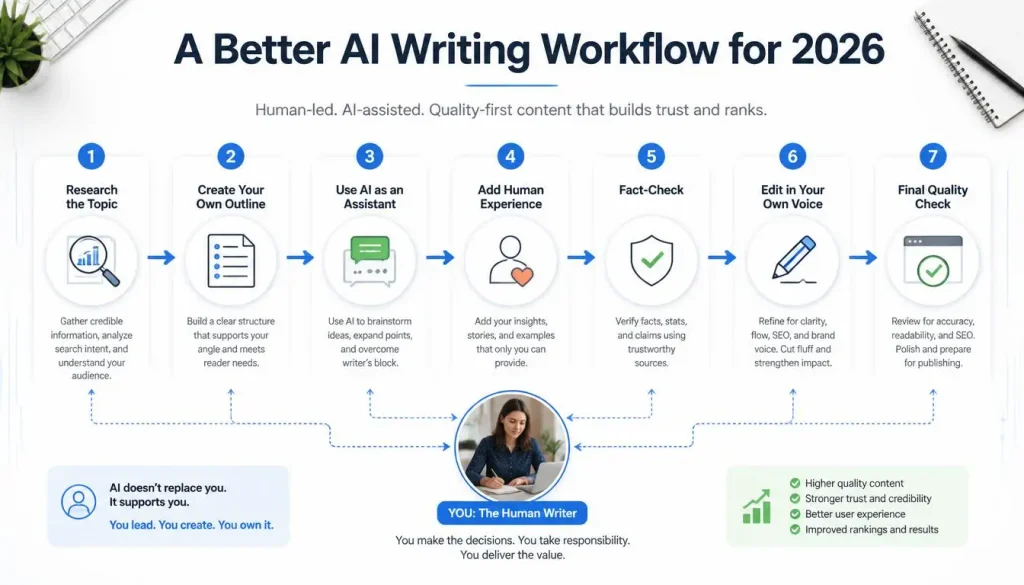
A Better AI Writing Workflow for 2026
If you regularly use AI for content, try this process:
1. Research the topic yourself.
Understand what readers actually want to know.
2. Create your own outline.
Decide what the article should say before asking AI to expand it.
3. Use AI as an assistant.
Let it help with structure, brainstorming, editing, or difficult sections.
4. Add human experience.
Include examples, observations, comparisons, and opinions that genuinely belong to you.
5. Fact-check everything important.
AI can confidently produce incorrect information.
6. Edit for your own voice.
Read the article aloud. Anything that does not sound like you should be reconsidered.
7. Publish only after a final quality check.
What Actually Works?
There is no reliable trick that guarantees a piece of writing will receive a particular AI-detection result.
What does work is much simpler: write something worth reading.
Use AI for speed, but bring the research, judgment, experience, and final editorial decisions yourself.
That approach also fits Google’s current people-first guidance, which emphasizes original, helpful, reliable content created for users rather than content designed mainly to manipulate search systems.
FAQs
Can AI-written content be made more human?
Yes. Strong editing, original examples, personal experience, specific details, and a natural writing voice can make AI-assisted content substantially more useful and authentic.
Do AI detectors always identify AI writing correctly?
No. Detection tools can produce false positives and false negatives. Turnitin itself says its AI report should be considered alongside other evidence and human judgment.
Should I use an AI humanizer?
Using a humanizer simply to bypass detection is not a dependable strategy. It is better to substantially edit the content and add genuine human input.
Does Google penalize AI content?
Google’s guidance focuses on content quality and purpose rather than simply whether AI was used. AI-generated content intended primarily to manipulate search rankings can violate spam policies, while useful, original content can be acceptable.
Final Takeaway
The future of AI writing is not about making machines look human.
It is about using machines without removing the human from the writing process.
Let AI handle repetitive work. Keep the research, experience, judgment, storytelling, and final editorial decisions in human hands.
That is what makes content feel original—and gives readers a reason to trust it.


0 Comments