Introduction
Artificial intelligence is moving beyond simple chatbots and becoming part of everyday work, education, business, search, and content creation. In 2026, new AI systems are becoming more autonomous, multimodal, personalized, and useful across different industries.
For students, creators, professionals, and business owners, understanding these changes can help identify new opportunities and prepare for the future.
In this guide, we’ll explore the 10 most important AI trends in 2026, including AI agents, generative AI, AI search, education, cybersecurity, and on-device models.
⚠️ Educational Disclaimer: AI technology changes quickly, and AI-generated information may contain errors. Verify important claims with reliable sources before making professional or high-stakes decisions. 📚
Executive Summary
| AI Trend | Main Benefit | Best For |
|---|---|---|
| AI Agents | Task automation | Businesses |
| Generative AI | Content creation | Creators |
| AI Assistants | Productivity | Everyone |
| AI Automation | Less repetitive work | Businesses |
| AI Search | Faster research | Students |
| AI Video | Easier production | Creators |
| Multimodal AI | Flexible interaction | Everyone |
| AI Education | Personalized learning | Students |
| AI Cybersecurity | Threat detection | Organizations |
| Small AI Models | Privacy and speed | Consumers |
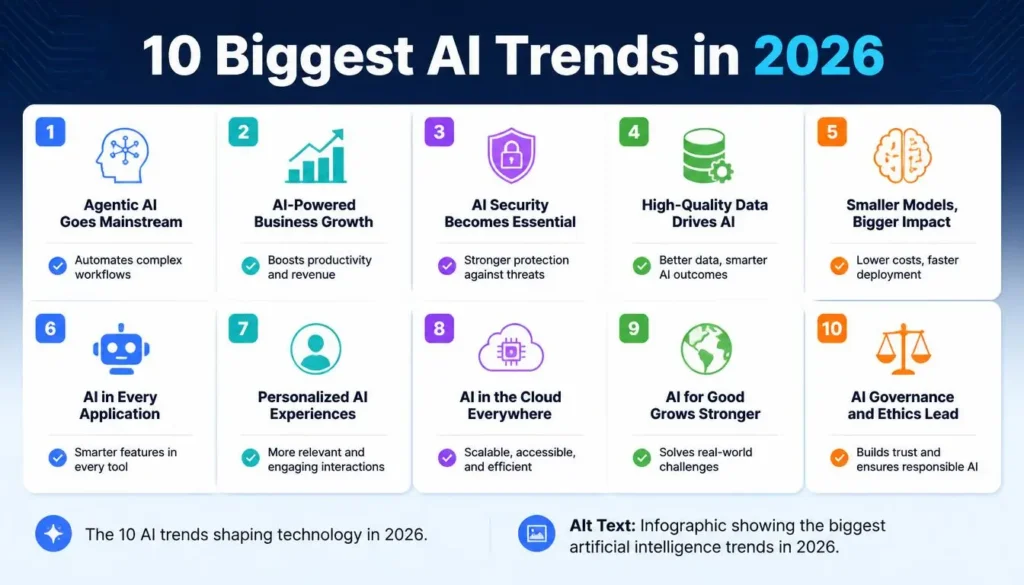
1. AI Agents Are Becoming More Autonomous
AI agents are one of the biggest developments in artificial intelligence. Unlike basic chatbots, agents can plan tasks, use tools, make decisions, and complete multiple steps with less human involvement.
Businesses can use agents for research, customer support, scheduling, data analysis, and project workflows.
The long-term goal is to make AI function more like a digital coworker rather than simply a question-answering tool.
2. Generative AI Keeps Expanding
Generative AI can create text, images, videos, audio, presentations, and code from natural-language instructions.
Businesses use it for marketing and documentation, while creators use it for content production and idea generation. Its biggest advantage is accessibility: people without advanced technical skills can now produce useful digital content much faster.
Internal Link Opportunity: Link “Best AI Tools for Content Creators” to your relevant NestAIHub article.
3. AI Assistants Are Getting Smarter
AI assistants are moving beyond answering questions. They can help users write emails, summarize information, analyze documents, plan tasks, and organize projects.
Students can use AI assistants for learning and research, while professionals can use them for everyday productivity.
The next generation of assistants will increasingly understand context and provide more personalized help.
4. AI Business Automation Is Growing
AI automation is becoming useful for small businesses as well as large organizations.
Common applications include:
- Customer support
- Scheduling
- Data entry
- Invoice processing
- Report generation
- Marketing workflows
Automating repetitive work allows employees to spend more time on creative and strategic tasks.
5. AI-Powered Search Is Changing Research
Search is becoming more conversational. Instead of entering short keywords and opening numerous pages, users can ask complete questions and receive organized answers.
AI search can summarize information, compare sources, explain concepts, and answer follow-up questions.
This makes it especially useful for students, researchers, writers, and professionals.
Internal Link Opportunity: Link “Best AI Research Tools for Students” to your relevant NestAIHub article.
6. AI Video Generation Is Growing Fast
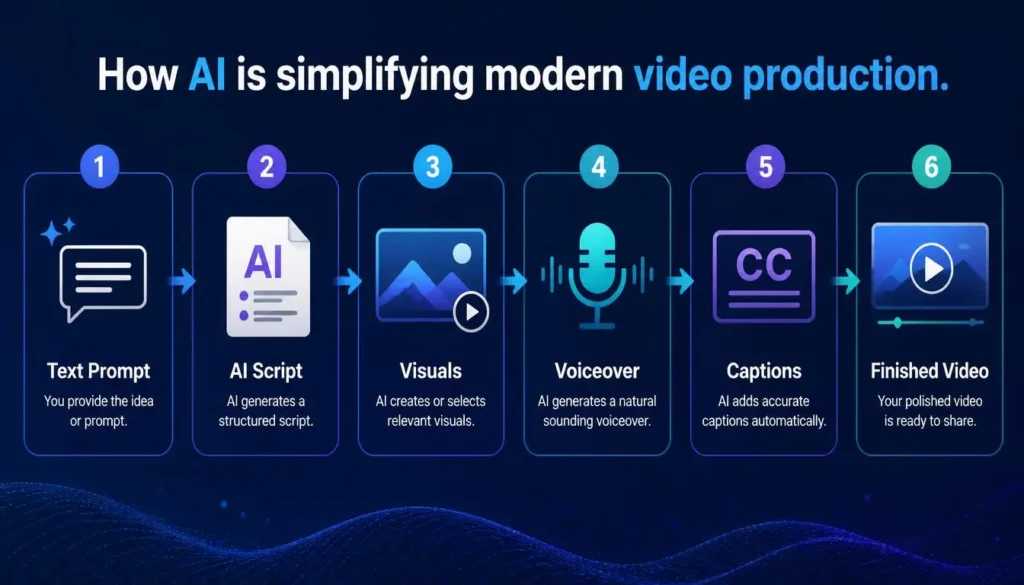
AI video tools are making video creation significantly easier. Users can create scripts, visuals, voiceovers, subtitles, and short videos with relatively simple instructions.
For YouTubers, marketers, educators, and social media creators, this can reduce production time and make professional-looking content more accessible.
7. Multimodal AI Is Becoming Standard
Multimodal AI can understand different types of information, including text, images, audio, video, and documents.
For example, a student can upload a diagram and ask an AI assistant to explain it. A professional could provide a document and ask for a summary.
This makes AI more flexible and closer to natural human interaction.
8. AI Is Transforming Education
AI is helping create more personalized learning experiences. Students can receive study explanations, practice questions, personalized learning plans, language support, and instant feedback.
AI isn’t necessarily replacing teachers. Instead, it can act as an additional learning assistant that allows students to practice and learn at their own pace.
Internal Link Opportunity: Link “Best AI Tools for Students” to your relevant NestAIHub article.
9. AI Is Strengthening Cybersecurity
Cybersecurity teams are increasingly using AI to detect unusual activity, identify potential threats, analyze large datasets, and respond to suspicious behavior.
Because AI can process huge amounts of information quickly, it can help organizations detect security problems earlier.
However, attackers are also using AI, making cybersecurity an ongoing technological competition.
10. Smaller AI Models Are Moving to Devices
Not every AI task needs a powerful cloud server. Smaller AI models can increasingly run directly on smartphones, laptops, and other devices.
This approach can provide faster responses, improved privacy, and some offline functionality while reducing dependence on cloud services.
AI Trends Comparison
| Trend | Main Impact | Primary Users |
|---|---|---|
| AI Agents | Automation | Businesses |
| Generative AI | Creation | Creators |
| AI Search | Research | Students |
| AI Video | Production | Creators |
| Multimodal AI | Interaction | Everyone |
| AI Education | Learning | Students |
| AI Cybersecurity | Protection | Organizations |
| Small AI Models | Privacy | Consumers |
How AI Will Affect the Future
AI is already changing education, business, marketing, entertainment, software development, and cybersecurity. The biggest opportunities will come from using AI to increase productivity rather than simply replacing existing processes.
At the same time, challenges such as privacy, misinformation, bias, job transformation, and AI accuracy will require responsible use and human oversight.
💡 Pro Tip: Don’t focus only on learning individual AI tools. Build transferable skills such as prompt writing, critical thinking, communication, problem-solving, and digital literacy. Specific AI platforms will change, but these skills will remain valuable.
Frequently Asked Questions (FAQs)
What are the biggest AI trends in 2026?
AI agents, generative AI, multimodal systems, AI search, AI video, education, automation, cybersecurity, and smaller on-device models are among the major trends.
Will AI replace humans?
AI will automate many repetitive tasks, but human judgment, creativity, communication, and decision-making will remain important.
What are AI agents?
AI agents are systems that can plan, use tools, make decisions, and complete multi-step tasks with limited human supervision.
Is AI worth learning in 2026?
Yes. AI skills are increasingly valuable for students, professionals, creators, freelancers, and business owners.
Final Verdict
The biggest AI trends of 2026 show that artificial intelligence is becoming more capable and deeply integrated into everyday life.
AI agents are automating workflows, generative AI is changing content creation, AI search is transforming research, and smaller models are bringing more AI directly to personal devices.
You don’t need to become an AI engineer to benefit. Start by learning practical AI tools, improving your prompting skills, and developing strong human abilities such as critical thinking and creativity.
The future belongs not simply to people who use AI, but to those who know how to use it intelligently.
About the Author
✍️ About the Author: Written by the NestAIHub Editorial Team, technology researchers and content editors covering AI tools, emerging technology, education, and digital productivity. 🧠
0 Comments