Introduction
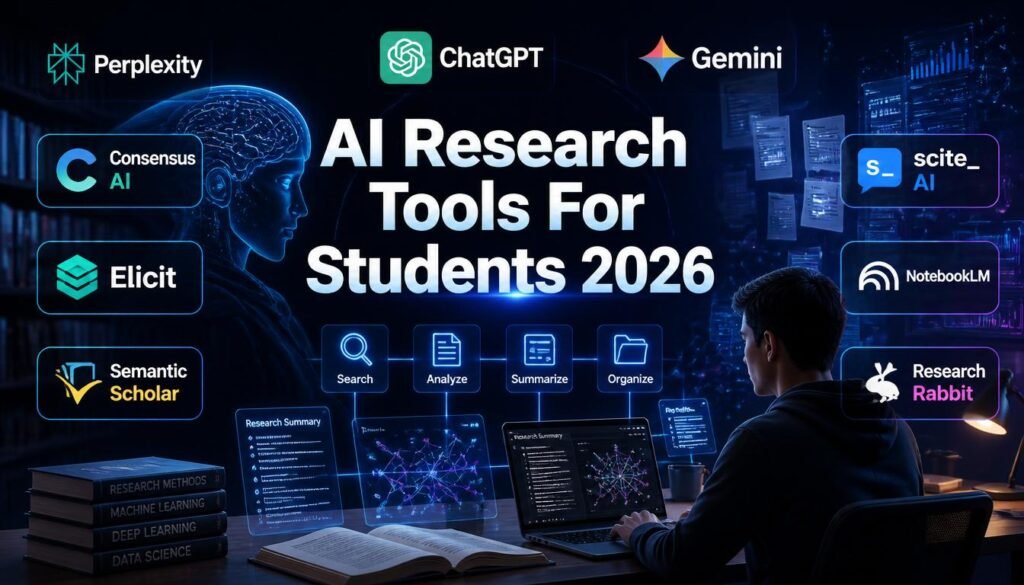
Research can take hours when students search through websites, books, papers, and scattered notes to find useful information. AI research tools are making this process faster by helping students discover sources, summarize documents, explain difficult concepts, and organize research.
The key is using AI as a research assistant, not as a replacement for critical thinking. Students should still check original sources and develop their own conclusions.
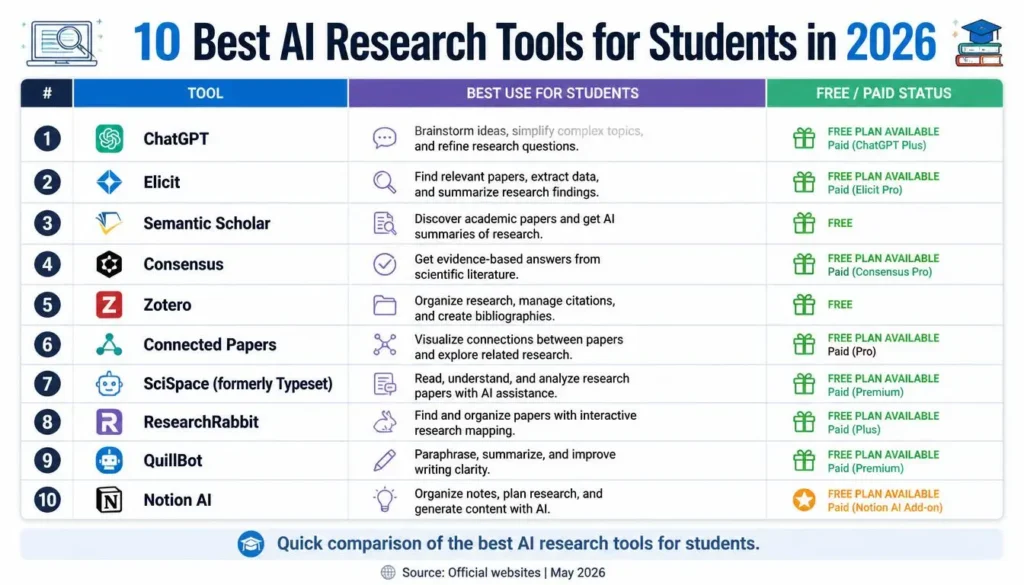
This guide covers the 10 best AI research tools for students in 2026, highlighting what each tool does best, its main strengths, and where it fits into an academic workflow.
⚠️ Educational Disclaimer: AI research tools support learning but should not replace independent thinking. Verify important facts with original sources and follow your institution’s academic integrity rules.
Executive Summary
| Tool | Best For | Free Option |
|---|---|---|
| Perplexity AI | General research | Yes |
| Google Gemini | Productivity | Yes |
| ChatGPT | Learning | Yes |
| Consensus | Scientific research | Yes |
| Elicit | Literature reviews | Yes |
| Semantic Scholar | Academic papers | Yes |
| Scite AI | Citation analysis | Limited |
| Connected Papers | Research mapping | Limited |
| NotebookLM | Documents | Yes |
| Research Rabbit | Paper discovery | Yes |
What Are AI Research Tools?
AI research tools use artificial intelligence to help students find, understand, summarize, and organize information. They can interpret questions, analyze documents, and provide conversational explanations.
Students can use them to find research, summarize papers, explain difficult concepts, compare sources, and organize notes. However, AI should speed up research—not replace source evaluation.
1. Perplexity AI — Best Overall
Perplexity combines conversational AI with web search and source references.
Best for: General research, source discovery, factual questions, and topic exploration.
Strength: Fast answers with citations and follow-up research.
Limitation: Verify important sources before using them academically.
2. Google Gemini — Best for Google Users
Google Gemini works well with Google Docs, Drive, and Workspace tools.
Best for: Research, productivity, document analysis, and brainstorming.
3. ChatGPT — Best for Learning
ChatGPT works as an interactive learning assistant. Students can simplify difficult concepts, brainstorm research ideas, summarize material, and ask follow-up questions.
Best for: Learning, explanations, writing, coding, and study support.
Limitation: Verify important academic claims.
Internal Link: Link AI tools for students to a relevant NestAIHub article.
4. Consensus — Best for Scientific Research
Consensus focuses on scientific literature and helps users find evidence from published research.
Best for: Science, psychology, social science, and evidence-based assignments.
It is especially useful when students need academic studies rather than general web content.
5. Elicit — Best for Literature Reviews
Elicit helps students discover academic papers, summarize findings, and compare studies.
Best for: Literature reviews, research papers, and dissertations.
It can reduce the time spent screening large numbers of papers.
6. Semantic Scholar — Best Academic Search
Semantic Scholar helps users discover scholarly publications, authors, citations, and related research.
Best for: Academic papers, scientific research, and literature reviews.
It is free to use, although some papers may require publisher or institutional access.
7. Scite AI — Best for Citation Analysis
Scite AI helps students understand how research papers are cited by later studies. It provides context around citations, helping users see whether research supports or challenges earlier findings.
Best for: Citation analysis, source evaluation, and academic writing.
Limitation: Full functionality may require a paid plan.
8. Connected Papers — Best for Research Mapping
Connected Papers creates visual maps showing relationships between academic publications.
Best for: Literature reviews and discovering related research.
Students can start with one relevant paper and explore connected studies.
9. NotebookLM — Best for Your Documents
NotebookLM is designed to work with user-provided material such as PDFs, notes, and research documents.
Best for: Document summaries, research notes, lecture material, and revision.
Simple Workflow
- Upload your papers or notes.
- Ask specific questions about them.
- Review the summaries and explanations.
- Check important claims against the original material.
Internal Link: Add your relevant NestAIHub article on AI study tools here.
10. Research Rabbit — Best for Paper Discovery
Research Rabbit helps students discover related papers, authors, and research through interactive networks.
Best for: Literature discovery.
Its recommendations help students explore a topic beyond the first papers they find.
How to Use AI Research Tools Responsibly
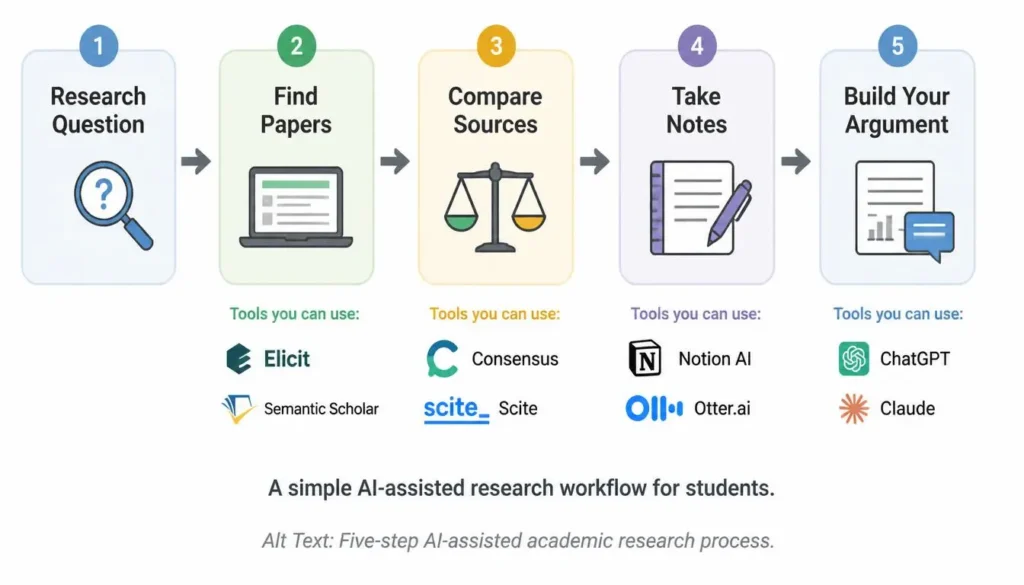
- Define your research question first.
- Use AI to discover information, not blindly accept answers.
- Open original sources and verify important claims.
- Compare multiple sources before reaching conclusions.
- Write your analysis independently.
- Follow your institution’s AI policy.
💡 Pro Tip: Don’t copy an AI-generated answer into an assignment. Use AI to find sources, explain difficult material, and organize notes, then build your final argument from verified evidence and your own understanding.
Common Mistakes to Avoid
- Trusting AI blindly: AI can produce incorrect information.
- Skipping original sources: Important claims need verification.
- Copying AI-generated work: Understand ideas and write independently.
Frequently Asked Questions (FAQs)
What is the best AI research tool for students?
Perplexity AI is a strong general-purpose choice because it combines AI answers with source references.
Which AI tool is best for academic papers?
Semantic Scholar, Consensus, Elicit, Scite, and Research Rabbit are strong options for academic literature.
Is NotebookLM useful for students?
Yes. It is useful for asking questions about uploaded PDFs, lecture notes, and research material.
Can AI replace traditional research?
No. AI can speed up searching and organization, but students still need to evaluate evidence and develop their own conclusions.
Are AI research tools accurate?
They can be very useful, but important information should always be verified against original and authoritative sources.
Final Verdict
AI research tools can make academic research faster and more organized. Perplexity is a strong all-around choice, Semantic Scholar is excellent for academic papers, Consensus is useful for scientific evidence, and NotebookLM works well with personal documents.
The best approach is to use AI for discovery, explanation, and organization while keeping source verification and critical thinking in your own hands. Used responsibly, these tools can help students spend less time searching and more time learning.
Our Advice for Students
AI research tools can make studying and research much easier, but every student has different needs. Some tools are better for finding papers, others for understanding difficult topics, checking sources, or organizing research.
Choose the tool based on your research needs, not just its popularity. Always check important sources yourself and use AI as a research assistant—not as a replacement for your own thinking.
About the Author
✍️ About the Author: Written by the NestAIHub Editorial Team, technology researchers and content editors covering AI, education, productivity, and practical technology guides.

0 Comments